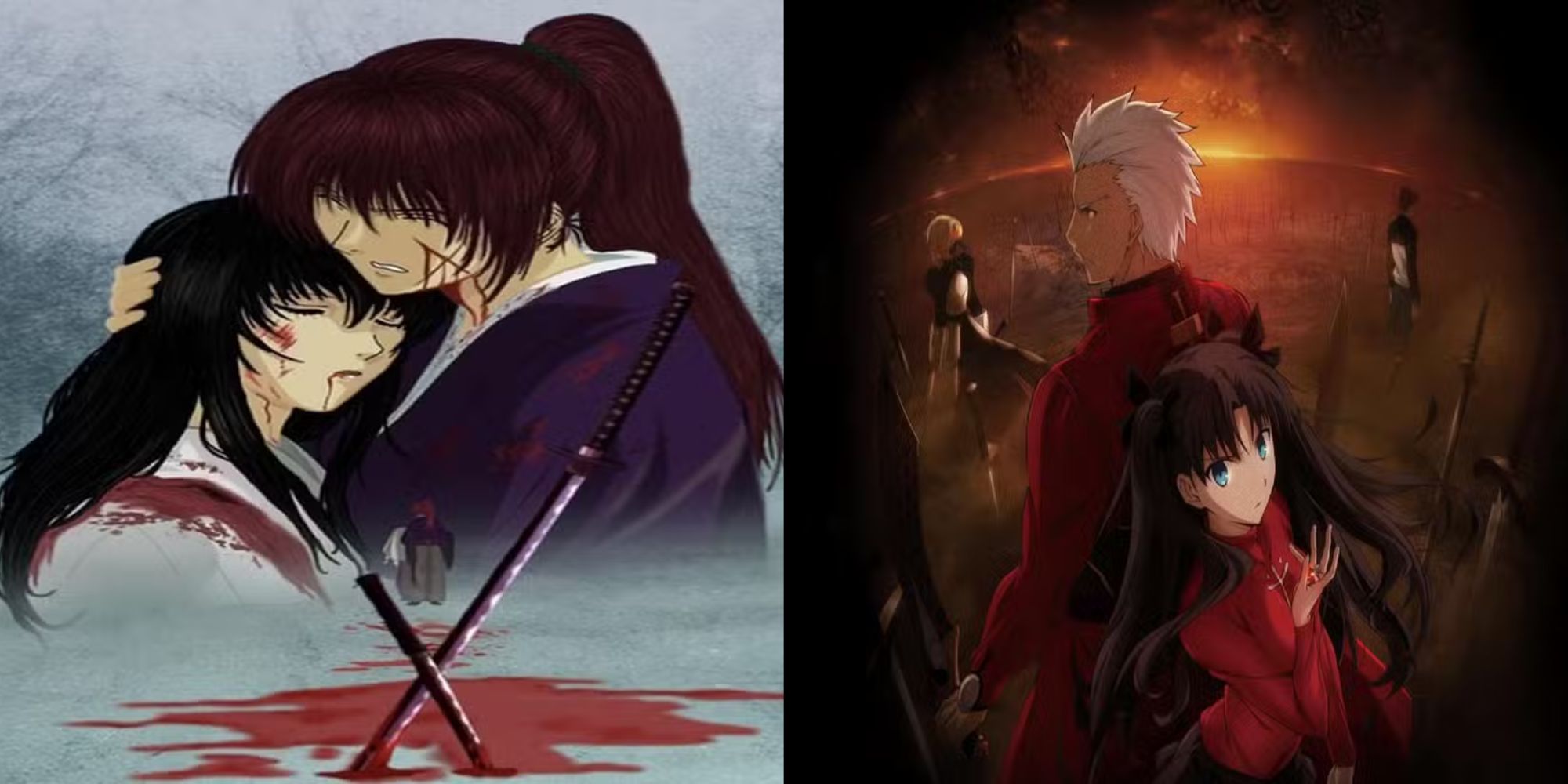

Studio Deen has always been an unpredictable force in the anime world. While they’ve never had the global prestige of Madhouse or the visual consistency of ufotable, their work spans genres, generations, and emotional extremes in a way few other studios can match.
Founded in 1975, Studio Deen built its name by animating some of the most iconic series of the late ’80s and early ’90s. But what sets Deen apart isn’t just their longevity, it’s their willingness to experiment, to adapt stories that no one else would touch, and to tell them in ways that stick with you, even when the polish isn’t perfect.
Related
20 Best Anime Series of All-Time
Here are 20 top anime series, each featuring exceptional storytelling, stunning animation, and unforgettable characters that have shaped the medium.
They’ve tackled chaotic comedies, deep tragedies, shonen sword fights, philosophical horror, and even self-parodying isekai, and surprisingly, many of their best works became fan favorites. In this list, we look back at some of the most memorable anime that Studio Deen has brought to life.
6
Didn’t you know? I’m Sakamoto
Coolest Guy in Every Room

Studio Deen took a bold turn in 2016 by adapting Nami Sano’s absurdist comedy manga Sakamoto Desu Ga?, and what came out of it was a short but unforgettable series that defied anime norms with deadpan flair.
The plot sounds simple: a high school boy who is, quite literally, too cool for everything. But this isn’t your average “cool guy” trope. Sakamoto doesn’t just dodge flying erasers midair or outsmart bullies, he does it while maintaining impeccable grace and charisma. His over-the-top reactions and oddly elegant solutions to life’s minor inconveniences are where the brilliance lies.
The anime runs for only 12 episodes and covers nearly all of the manga’s chapters, with an unaired 13th episode released later as an OVA. Studio Deen leaned into the show’s deadpan delivery with exaggerated visual direction, freezing time, sudden camera angle shifts, and a jazzy, confident soundtrack to mirror Sakamoto’s untouchable aura.
There’s minimal character growth here, by design. The anime’s genius lies in its repetition and how each scenario dares you to believe there’s no way Sakamoto can outdo himself again, until he does. He escapes fires, stops delinquents with a straw wrapper, and even gracefully works at a fast food restaurant like a five-star maître d’.
Though it may not boast emotional depth or high-stakes conflict, Didn’t You Know? I’m Sakamoto stands as one of Studio Deen’s most polished and unique comedy offerings. And yes, it’s fully dubbed, just in case you want to hear “Sakamoto desu ga?” with maximum English swagger.
5
Fruits Basket
The Zodiac Curse That Deserved More Time

Long before the beloved 2019 reboot, Studio Deen introduced anime fans to Fruits Basket in 2001, adapting Natsuki Takaya’s early manga volumes into a 26-episode series that gained a loyal following, despite its many flaws.
At its heart, Fruits Basket is the story of Tohru Honda, an orphaned high school girl who finds herself living with members of the mysterious Sohma family. What seems like a slice-of-life setup turns into something deeper as we learn that several Sohma members are possessed by animals of the Chinese zodiac, cursed to transform whenever they are embraced by someone of the opposite sex.
Studio Deen’s version captured the quirky charm and emotional undertones of the manga’s early arcs, but it suffered from a major limitation: it was produced before the manga was complete. As a result, the anime diverged from the source material, lacked resolution, and never fully explored the darker, more intense themes Takaya later introduced in her work.
Still, the original Fruits Basket had its strengths. The voice acting in both Japanese and English dubs stood out, especially Laura Bailey as Tohru in the dubbed version. Its melancholic soundtrack and stylized backgrounds helped elevate quieter emotional moments, even when the animation quality fell short.
Though it’s since been overshadowed by the more faithful and emotionally complete 2019 adaptation by TMS Entertainment, Studio Deen’s Fruits Basket was essential in giving the franchise its first taste of international recognition.
4
KonoSuba: God’s Blessing on This Wonderful World!
Isekai Has Never Been This Beautifully Chaotic

With KonoSuba, Studio Deen proved that you don’t need perfect animation or an emotionally deep protagonist to create a fan-favorite isekai. Based on Natsume Akatsuki’s light novel series, KonoSuba turned the fantasy adventure genre upside down with its self-aware humor, broken characters, and complete lack of reverence for traditional isekai tropes.
Kazuma, a teenage shut-in, dies in one of the most pathetic ways imaginable, by shock, thinking he saved a girl from a truck (it was a tractor, and she didn’t need saving). In the afterlife, he’s offered a choice: take any item or person with him to a fantasy world. In a moment of pettiness, he chooses the annoying goddess Aqua herself. From there, the misadventures begin.

Related
10 Most Rewatchable Anime
Here are 10 anime that you can rewatch countless times and never get tired of.
Aqua is useless. Megumin can only cast one spell a day. Darkness is… deeply committed to her masochism. But together, they make one of the most dysfunctional and hilarious parties in isekai anime history.
Despite inconsistent art quality, often mocked even by fans, Studio Deen leaned into comedic timing, exaggerated facial expressions, and chaotic pacing. The studio’s approach turned budget constraints into a running joke, especially in Season 1 (2016) and Season 2 (2017), both of which remain immensely rewatchable.
The series gained a massive Western following thanks to its early streaming availability and stellar English dub. Its influence on other comedy-isekai series can’t be overstated. Even now, fans continue to reference KonoSuba’s freeze spell, explosion obsession, and that infamous “panty-stealing” moment.
3
Rurouni Kenshin: Trust & Betrayal
The Swordsman Who Chose Peace Over Vengeance

Before Studio Deen took over, Rurouni Kenshin had already become a massive hit under Studio Gallop and Studio Deen’s co-production. But starting around episode 28, Deen fully assumed control, and their contribution included much of the iconic Kyoto Arc, which is widely considered the anime’s best.
The series follows Himura Kenshin, once known as Battousai the Manslayer, a legendary assassin of the Bakumatsu era who now vows never to kill again. He travels Japan helping others, wielding a reverse-blade sword as both penance and protection.
Deen’s handling of the Kyoto Arc introduced Makoto Shishio, a burnt and bandaged ex-assassin who serves as a perfect ideological foil to Kenshin. The animation quality during this stretch significantly improved, showcasing some of the most fluid and intense sword fights of the mid-90s. One of the standout moments, Kenshin vs. Saito Hajime, is still discussed today in anime forums for its brutal choreography and philosophical clash.
Characters like Misao, Aoshi, and the Oniwabanshu added emotional depth, while the music, especially tracks like “Heart of Sword” by T.M. Revolution, cemented the anime’s legacy. The English dub, produced by Media Blasters, received strong praise for its faithfulness and solid performances, especially Kenshin’s soft-spoken yet heavy-hearted demeanor.
Studio Deen’s contribution to Rurouni Kenshin laid the groundwork for the anime’s enduring popularity, helping it gain a devoted international fanbase and setting the stage for its later OVAs.
2
When They Cry: Kai
The Answers That Made the Screams Worthwhile

For those who braved the terrifying loops and psychological horrors of Higurashi no Naku Koro ni, Studio Deen’s sequel, Higurashi: When They Cry – Kai (2007), delivered what fans desperately needed: answers.
The original Higurashi left viewers haunted and confused. Each arc reset the story, showing the same characters in the same village of Hinamizawa, but with wildly different and often gruesome outcomes. The first season offered no clear reason why friends turned on each other or why death kept repeating. Kai picked up from there, not just continuing the story, but explaining it.
Adapted from the “Answer Arcs” of 07th Expansion’s visual novel, Kai revealed that the horror wasn’t random, it was tied to Hinamizawa Syndrome, a parasitic infection that triggered madness under stress. But it also introduced something deeper: a story about friendship, trust, and defying fate.
Rika Furude, once seen as a passive observer, became the emotional core. She’s been living through countless loops, dying again and again, trying to find a world where she and her friends survive. Kai turned her from a mysterious mascot into a tragic, determined protagonist.
The writing got more complex too. Kai explored governmental cover-ups, underground labs, and even philosophical questions about willpower and destiny. Studio Deen approached this season with more care and cohesion than the first, improving the pacing and connecting the arcs in a way that finally made the story feel complete.
The animation remained modest, with occasional off-model designs, but the storytelling was so strong that fans looked past the visuals. The voice acting, particularly Yukari Tamura as Rika and Mai Nakahara as Rena, gave the characters raw emotional weight. The English dub, released later by Sentai Filmworks, was serviceable, but most fans still recommend the Japanese audio to feel the full impact.
1
Fate/StayNight
The Route That Started It All


Fate/Stay Night
- Release Date
-
January 7, 2006
- Directors
-
Yūji Yamaguchi
- Writers
-
Takuya Sato
Before Fate/Zero and Unlimited Blade Works earned ufotable its reputation, it was Studio Deen who first brought Fate/Stay Night to screens in 2006, adapting Type-Moon’s wildly popular visual novel into a 24-episode anime.
The story follows Shirou Emiya, a high school student who gets roped into the deadly Holy Grail War, summoning the heroic spirit Saber to fight alongside him. The war pits seven mages and their legendary servants against each other, with the winner claiming the Grail, a magical artifact that grants wishes.
Deen’s adaptation combined elements from both the Fate and Unlimited Blade Works routes, though it stuck primarily to the Fate route focusing on Shirou and Saber. While criticized for cutting complex lore and underdelivering on animation, especially during action scenes, the series had its own appeal, especially for newcomers to the franchise.
Ayako Kawasumi’s performance as Saber remains iconic, and the music, composed by Kenji Kawai (Ghost in the Shell), carried an epic yet melancholic atmosphere. The English dub, though inconsistent, helped introduce a generation of Western fans to the Holy Grail War.
Studio Deen’s version is also the first to explore the ideals that would later define Shirou: his reckless selflessness, his obsession with becoming a “hero of justice,” and the contradictions at the heart of that dream. These themes would later be expanded upon in Fate/Zero and Heaven’s Feel, but Deen’s adaptation was the door that opened the universe.
Looking back, the 2006 series may not be the best Fate anime, but without it, there may have never been a Fate anime boom at all.

Next
10 Most Underrated Anime That Deserves More Recognition
With so many anime out there, many gems go unnoticed. Here are some underrated anime that deserve more recognition.