
If you’re a game developer, one of the cardinal rules that you’ll learn is, if you find a gameplay loop or hook that works, milk that sucker dry.
If a player likes what you’re doing, they’ll likely want more of the same, and any deviation from this effectively runs the risk of losing their attention, and having them bounce to a new game.
Finding that hook is good advice, but some brave developers have found great success by drastically changing things up, serving as quite the paradigm shift in each of their respective games.
Whether it’s midway through proceedings, or frequently over the course of the game, these devs have been brave enough to make their games genre fluid or take big narrative risks to shock and excite players.
Sometimes it works; sometimes, it’s a tough pill to swallow, but no matter what, it’s always interesting. As proven by these titles that aren’t afraid to flip the script midway through.
For the sake of clarity, we will be including games that change drastically at any point in their runtime, will include both gameplay and narrative changes, and will include games that constantly change rather than offering one standout paradigm shift.
10 This list will effectively spoil and potentially ruin the shocking twists these games have planned for you, so proceed at your own peril!A Dark Room
A Text-Based Twist
Adventure
Indie Games
Strategy


- Released
- June 10, 2013
- Developer
- Doublespeak Games, Amir Rajan, Scratchwork Development LLC
- Publisher
- Doublespeak Games, Amir Rajan, Scratchwork Development LLC
- Engine
- alien alloy
- ESRB
- t
- How Long To Beat
- 4hours
It’s rare that I go into the deep recesses of gaming culture to dig up an old free to play flash game relic, but A Dark Room is so good that I can’t help myself.
A Dark Room is a text-based title that starts off as simple as ever, as you give basic commands to explore the world you are being described, and over time, you’ll be able to gather context and make sense of what lies in the darkness.
However, as the game processes, it pivots to a resource management game as you try to build your camp, and before long, you find yourself in a sort of CIV adjacent space race toward the end.
It’s one of the most clever and well-paced gaming experiences I’ve ever had the pleasure of sitting down to enjoy, and while it’s about as simple as they come, I would still say it’s worth checking out today.
9 Little Inferno
Some People Like To Watch The World Burn

Little Inferno is one of the most fun, satirical jabs at the gaming industry. On paper, it really shouldn’t double as a great game as well as a comment on consumerism, but against all odds, it’s a very addictive title.
This game sees you purchase items, which you will then need to burn to keep yourself warm in this dystopian world that capitalism has created. It’s a mindless little puzzle game that has you pair items to burn to get more items. But it’s when you’ve burned everything, and I mean everything, the tone changes.
The fun stops as you are given a view of your character for the first time, and you play a point-and-click sequence as you wander the bleak world.
You get to see the effects of consumer culture for yourself, and in the end, all you can do is hope that the future is brighter than the flames you fueled. It’s a weird little game, but one I highly recommend for a fun, short, good time.
8 In Stars And Time
Not Just A Simple JRPG Story

In Stars and Time is one of my favorite indie games ever made, mainly because of its incredible writing and its ability to offer a phenomenal, meta time loop framework.
However, the game starts off relatively linear in a lot of ways. You simply need to work through the castle, use your time-looping powers to fix your mistakes, and take down The King to save the world. All pretty standard JRPG stuff.
However, upon defeating the evil that plagues the realm, time loops again regardless of your victory, and suddenly, you’re no longer playing a JRPG. You’re locked into a time loop puzzle, and only through exploration, time manipulation, and descending into madness will you be able to solve it.
There truly is nothing on the market like this game, and I couldn’t recommend it higher, so step into the shoes of Siffrin and get going.
7 The Last of Us Part 2
Know Thy Enemy


- Released
- June 19, 2020
- Publisher(s)
- Sony
- Engine
- Proprietary
- ESRB
- M for Mature: Blood and Gore, Intense Violence, Nudity, Sexual Content, Strong Language, Use of Drugs
- How Long To Beat
- 24 Hours
- X|S Optimized
- no
- Metascore
- 93
- Steam Deck Compatibility
- yes
- OpenCritic Rating
- Mighty
- Cross Save
- no
- Cross-Platform Play
- no
I said that not all of these paradigm shifts were universally popular, and TLOU2’s midway change is about as divisive as it gets.
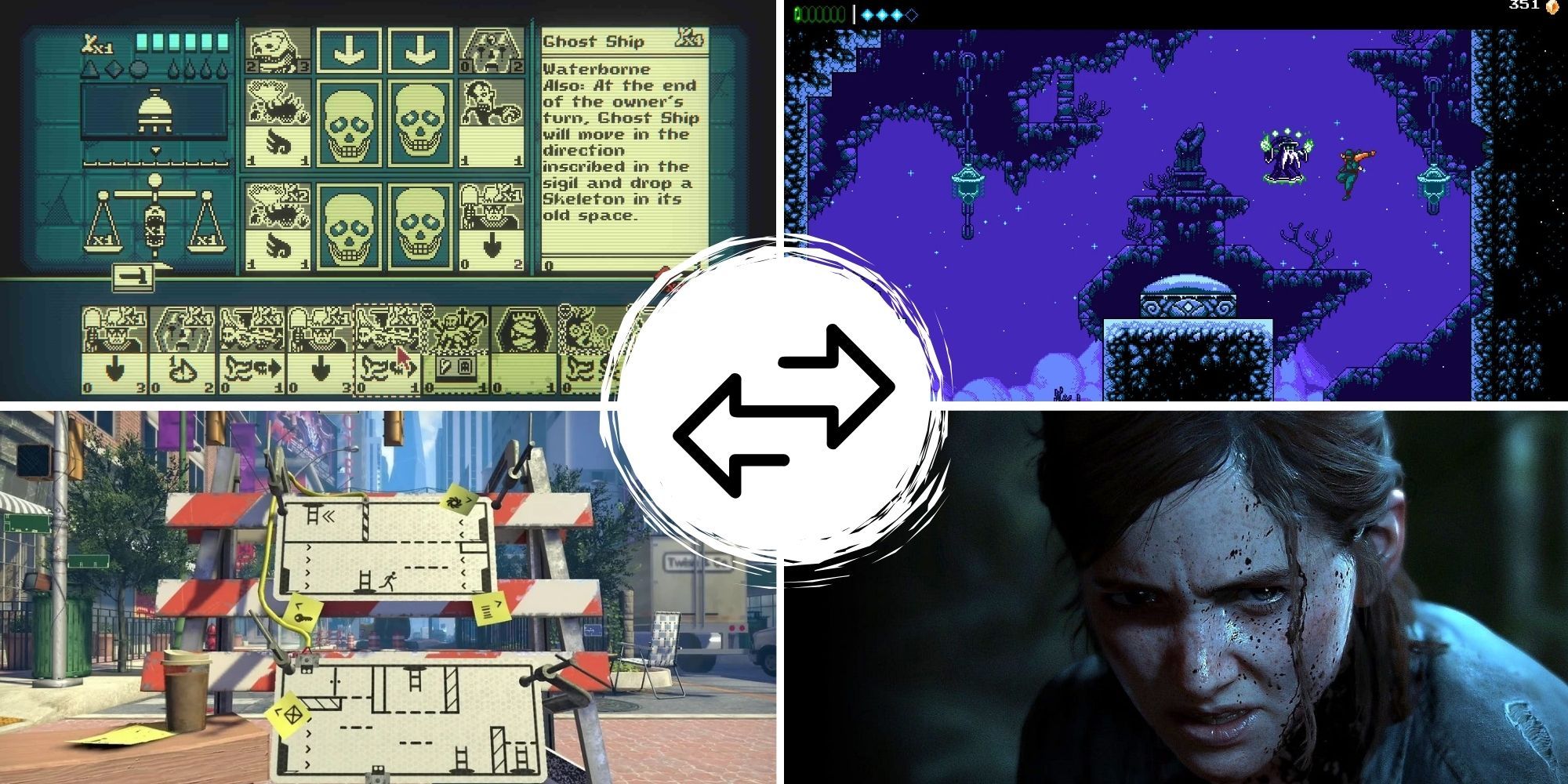
This change sees you reach a critical point in the story, playing as Ellie, only to jump back in time and be placed in the shoes of the game’s antagonist, Abby. Forcing the player to see the villain’s perspective.
While a lot of people hated this, I actually had a lot of time for this decision. As it’s a bold narrative choice that humanizes the antagonist and makes you partly responsible for their actions.
The gameplay remains largely the same from one character to the other, but the whiplash that comes with stepping into the shoes of your nemesis is one that will rock many players.
6 The Nier Series
The Ol’ Yoko Taro Mess Around

I could have included just about any game produced by Yoko Taro, as the Nier series is one that produced games that simply refuse to stick to a genre, or a narrative thread for that matter. So, I’ll just go ahead and give the nod to the entire series.
The games are all over the place, usually offering a central focus on hack-and-slash gameplay but branching out into all sorts of other areas frequently and liberally.
Your hack-and-slash combat might suddenly be swapped out for some twin-stick bullet hell action. Then you’ll need to switch gears again when the game pivots to a side-scrolling 2D platformer, or a puzzle-based survival horror. In short, just when you think you have this game pegged, it changes things up again.
It’s hard to believe that with the amount of big swings this Drakengard spin-off has taken, that it would still be so popular. But the weird, unpredictable nature of Nier is part of the charm, and the prime reason why you should embrace the weird sometime soon.
5 Brutal Legend
Front-loading Action Into A Strategy Game


- Released
- October 13, 2009
- Publisher(s)
- Electronic Arts
- Multiplayer
- Local Multiplayer
- Engine
- Unreal Engine 2.5
- ESRB
- m
- How Long To Beat
- 9 Hours
Brutal Legend is possibly the most blatant example of false advertising in the history of gaming, perhaps aside from Alien: Colonial Marines.
This game stars you in the role of Eddie Riggs, a metal fanatic that has been transported to the realm depicted in his heavy metal CD covers, and through the power of slaying riffs, you’ll need to become the savior of the broken, the beaten and the damned.
The game begins as a typical action adventure with traditional hack-and-slash combat. But, as it turns out, this was a late development add-on to hide the fact that the rest of the game was an RTS game, which, no matter what way to skin it, is a harder sell to casual gamers.
It’s a blend that didn’t mix all that well, in all honesty, but thanks to some great voice work, killer tracks, and some cool ideas from the mind of Tim Schafer, the game still serves as a novelty worth checking out regardless.
It didn’t quite get booed off the stage, but this one could have definitely rocked a lot harder.
4 The Pedestrian
From 2D To 3D Action

I’m a sucker for a puzzle game that offers a core concept that feels unlike anything else, and The Pedestrian certainly was that.
This title is a 2D puzzle platformer where you’ll need to guide your little stickman and make connections, allowing them to access doors, switches, and apparatus needed to get from A to B.
It sounds rudimentary, but that’s the charm of this game, as it’s so easy to understand, but offers a wealth of puzzles that are real cerebral workouts. However, none are as memorable, challenging, or polarizing as the final puzzle.
This is because the game swaps from a 2D puzzler to a 3D puzzler, asking you to use the same logic and connections to solve a puzzle while occupying the 3D plane. It’s a change that is tough to get your head around and serves as an awesome finale to what is a criminally underrated puzzler.
3 The Messenger
Linear Platforming Gives Way To Backtracking

- Released
- August 30, 2018
- Developer(s)
- Sabotage
- Engine
- Unity
- ESRB
- E10+ For Everyone 10+ Due To Crude Humor, Fantasy Violence, Language
- How Long To Beat
- 12 Hours
- OpenCritic Rating
- Mighty
There’s a lot to love about the games that come out of Sabotage Studios. From the modern meets retro vibe to the corny writing and awesome soundtracks, everything they do has a certain unique charm to it. But what stands out about their games is the risks they take in terms of design, and that is clear as day when playing The Messenger.
This game from the offset is a ninja platformer, mirroring the likes of old retro hits like Ninja Gaiden. However, as the game progresses, you’ll suddenly find yourself playing a much more open-ended Metroidvania.
Is it the most involved and refined Metroidvania in the world? Obviously not. But it’s a shift that keeps things exciting and is a welcome change after hours of linear platforming that really feels like it has ran its course by the time the change kicks in.
2 Elden Ring
Boss Rush Incoming

- Released
- February 25, 2022
- Engine
- Proprietary
- ESRB
- M for Mature: Blood and Gore, Language, Suggestive Themes, Violence
- How Long To Beat
- 58 Hours
- X|S Optimized
- yes
- Metascore
- 96
- Platforms That Support Crossplay
- PS4 & PS5 and Xbox One & Xbox Series X|S
- PS Plus Availability
- N/A
- Steam Deck Compatibility
- yes
- OpenCritic Rating
- Mighty
- Cross Save
- no
- Cross-Platform Play
- PS4 & PS5 and Xbox One & Xbox Series X|S
Elden Ring was a huge leap forward for FromSoftware as they finally realized their dream of producing an open-world Souls game.
The process of going from maidenless to an Elden Lord is largely an open-ended one where you can go anywhere and do anything in an order that suits you, and if something is too tough, you could always try something else and return bigger and stronger.
However, when you burn the Erdtree and enter the final straight toward the end of the game, suddenly this experience becomes more in line with the funneled gauntlet runs that older souls titles tended to be.
The path to your final fight against the Elden Beast is effectively a boss rush where you either repeatedly bash your head against the skill wall until you break through, or walk away defeated.
It’s a real shift from the open nature of the title up to that point and is a common jumping-off point for less tenured souls players.
1 Inscryption
A Top-Down Twist

- Released
- October 19, 2021
- Developer(s)
- Daniel Mullins Games
- Engine
- Unity
- ESRB
- M For Mature 17+ due to Blood, Strong Language, Violence
- How Long To Beat
- 13 Hours
- PS Plus Availability
- Extra & Premium
- OpenCritic Rating
- Mighty
If I’m honest, I could have put any of Daniel Mullin’s games on this list, but it’s pretty much unanimously accepted that Inscryption is his best work. This game begins as a genre-hybrid, acting as a Roguelike deckbuilder paired with an escape room scenario.
Which is as eerie, intriguing, and addictive as it sounds. However, as soon as you think you have a handle on things, the game tosses you a curve ball.
Alongside some ARG-fuelled narrative and surreal moments, the game suddenly switches to a top-down RPG card-collect-a-thon.
It thankfully maintains a lot of the same card-based mechanics as the first half, but frames them in a completely new way that takes some getting used to. It’s a shift that keeps you on your toes, and keeps things fresh right until the credits roll.

NEXT
10 Underrated Games Consoles That Deserved Better
Not every console can be a world-beater, but these systems had a lot going for them.