
The art of the sequel is an exceptionally difficult and delicate one.
It’s not that hard to just dump a bunch of existing characters into a half-baked new adventure.
It takes real dedication and vision to create a sequel that not only utilizes established designs, but elevates them in novel ways.
Related
15 Games That Deserve A Sequel
Just because a game is critically acclaimed doesn’t mean it will receive a sequel. Here are some games that are in dire need of another game.
This is a particularly tricky prospect in JRPGs, which tend to be very large, intricately-designed games from the outset.
Despite the high bar, there have been plenty of JRPG sequels over the years that have successfully cleared it.
These games took settings, characters, and mechanics that we already knew and either evolved them or took them off in entirely unexpected directions.
10 Kingdom Hearts 2
High-Flying Action



- Platform(s)
- PS2 , PS3 , PS4 , PC
- Released
- March 28, 2006
- Engine
- Unreal Engine 4
- ESRB
- E10+ For Everyone 10+ Due To Mild Blood, Use of Alcohol, Violence
- How Long To Beat
- 32 Hours
The original Kingdom Hearts remains one of the wildest hail marys ever thrown by the game industry, and that’s saying something.
Combining Disney and Final Fantasy wasn’t something anyone expected, and the odd idea wasn’t without its rough edges.
Still, it managed to stake a claim on our hearts, which was cemented even further by Kingdom Hearts 2.
Everything about Kingdom Hearts 2 was improved, with particular emphasis on more action-packed, high-flying combat.
The introduction of the Reaction Command system for situational super-moves was a stroke of brilliance that’s stuck with the franchise to this day.
9 Mother 3
More Laughs, More Tears

- Released
- April 20, 2006
- Developer
- Brownie Brown, HAL Laboratory
- Engine
- M4A sound/music engine
- ESRB
- e
- How Long To Beat
- 25 Hours
Mother and Earthbound are both brilliant games, combining amusingly off-kilter settings with a novel combat system.
However, the true realization of Mother’s identity was really achieved with the release of Mother 3.
Mother 3 introduced both quality-of-life features like dashing and cool combat wrinkles like the rhythmic attack system.
Moreover, Mother 3’s more advanced character animation helped to tell a story that really tugged at your heartstrings all the way through.
There’s a reason people still want this game to come westward decades later: it’s just that good.
8 Persona 3
Establishing Its Own Identity

- Platform(s)
- PS3 , PS2 , PSP
- Released
- July 13, 2006
- Engine
- unreal engine 4
- ESRB
- M for Mature: Blood, Language, Partial Nudity, Violence
- How Long To Beat
- 80 Hours
- Metascore
- 86
Megami Tensei is one of the oldest JRPG franchises out there, notable for, among other things, its sheer number of spin-offs.
One of those spin-offs was the original Persona game, which put a greater emphasis on contemporary settings and characters.
While the first two Persona games weren’t bad by any means, they were still pretty heavily rooted in Megami Tensei’s mechanics.
This changed with the release of Persona 3.
Persona 3’s weakness-hunting combat and regimented calendar created an addicting gameplay loop that has since allowed Persona to become a juggernaut in its own right, independent of its roots.
7 Pokémon Gold & Silver
A New Realm Of Pocket Monsters

- Released
- October 14, 2000
- Multiplayer
- Local Multiplayer
- Engine
- unreal engine
- ESRB
- e
- How Long To Beat
- 30 Hours
While we take for granted that every new Pokémon game is going to take us to a new region with new Pokémon these days, that wasn’t always the case.
In the old days of Red & Blue, it was 150 and no more (unless you cheated and caught Mew).
The release of Pokémon Gold & Silver, however, completely threw all of us for a loop.
Just like that, we had not only an entire new region to explore, but 100 new Pokémon to catch, not to mention new types in Steel and Dark.
6 Paper Mario: The Thousand-Year Door
Wilder And Wackier

- Franchise
- Paper Mario
- Released
- October 11, 2004
- Engine
- Origami King’s engine
- ESRB
- E For Everyone Due To Mild Cartoon Violence
- How Long To Beat
- 31 Hours
- Metascore
- 87
- OpenCritic Rating
- Mighty
The original Paper Mario was released in 2000 for the Nintendo 64.
It was a big evolution on Mario’s previous RPG adventure, but while it was a great game, it was missing a certain something.
Whatever that something was, they apparently found it and put it in The Thousand-Year Door.

Related
10 Best Games Like Paper Mario: The Thousand Year Door
Wrapped up with 2024’s remake of The Thousand-Year Door, but hungering for more? Try out one of these Paper Mario-inspired gems!
Thousand-Year Door is a direct improvement on its predecessor, with more varied and strategic combat, bigger and more bombastic setpieces, and a generally wider world to explore.
It managed all of this while still being a very accessible and family-friendly game, which is an accomplishment in itself.
5 Bravely Default 2
Broader JRPG Appeal

- Released
- February 26, 2021
- Developer
- Claytechworks
- Publisher(s)
- Nintendo
- Engine
- Unreal Engine 4
- ESRB
- T for Teen: Mild Blood, Mild Suggestive Themes, Use of Alcohol, Violence
- How Long To Beat
- 50 Hours
- Metascore
- 83
- OpenCritic Rating
- Strong
If you want to get technical about it, Bravely Default 2 is actually the third Bravely Default game.
The original Bravely Default had a direct sequel, Bravely Second, but Bravely Default 2 is the second overall game in the series.
The transition from 3DS to Nintendo Switch certainly brought with it a greater degree of technical complexity and presentation.
Bravely Default 2 incorporated a lot of smart design choices that made the series a little more accessible to JRPG fans at large.
This includes deeper, more nuanced combat, swapping out random encounters for enemy field symbols, and a generally faster introduction to the story.
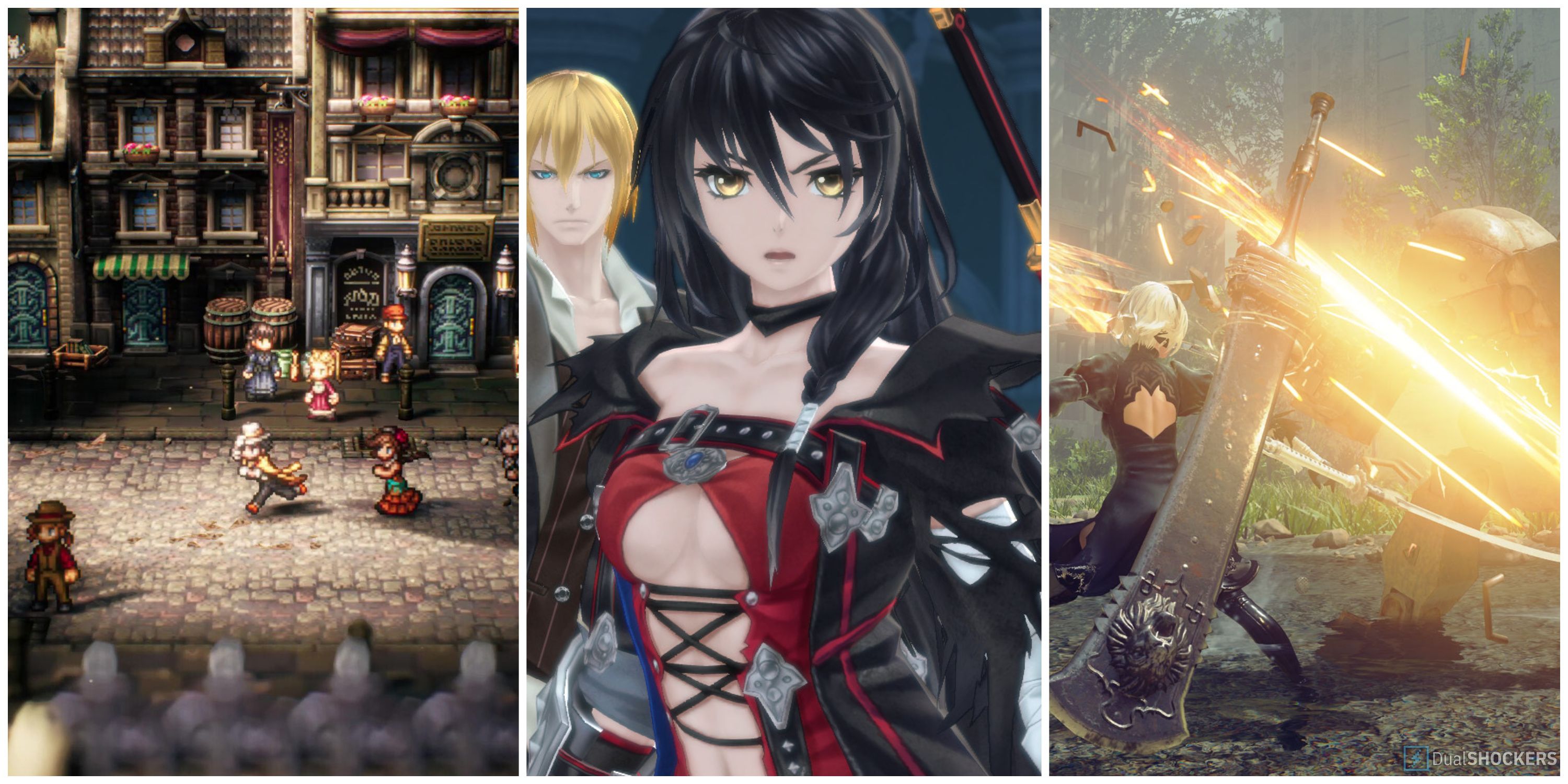
4 Octopath Traveler 2
Stories Intersect

Octopath Traveler was Square Enix’s first “HD-2D” game, a new kind of art style combining traditional pixel sprites with high-res artwork and backgrounds.
It was a great game, though there were some shortcomings, particularly the lack of interaction between character stories.
Octopath Traveler 2 solved this problem and more, bringing the characters closer together in their own stories as well as making it much easier to experience the big finale at the end.
It’s also packed with quality of life improvements such as faster combat speed, job overhauls, and travel banters that can’t be missed.
3 Tales Of Berseria
Building A Future From The Past

- Released
- January 24, 2017
- Engine
- Unreal Engine 4
- ESRB
- T For Teen Due To Blood, Mild Language, Mild Suggestive Themes, Partial Nudity, Use of Alcohol, Violence
- How Long To Beat
- 44 Hours
- OpenCritic Rating
- Strong
2015’s Tales of Zestiria was a bit of a gamble on the series’ part, ditching many established gameplay norms in the hopes of building something new.
The end result was… a bit iffy, to put it diplomatically, but these problems were swiftly remedied in the game’s direct follow-up, Tales of Berseria.
Tales of Berseria majorly refined all of the new gameplay elements introduced in Zestiria to create combat and exploration systems with much better flow.
Berseria also built upon Zestiria’s established story in new and interesting ways thanks to being a prequel.
2 NieR: Automata
A Fighting Machine

The original NieR: Replicant was a bit of an odd duck of an action JRPG.
The combat was somewhat lacking in polish, and while the story was excellent, it was also a bit difficult to wrap your head around in one playthrough.
NieR: Automata packs the polish that Replicant lacked, thanks in large part to an intricately-built combat system courtesy of character-action veterans Platinum Games.
Automata’s story is also a bit more coherent than Replicant’s, while still featuring plenty of that high-concept weirdness you like from a Yoko Taro production.
1 Shadow Hearts: Covenant
Improving On A Cult Classic

The original Shadow Hearts was a cult classic JRPG of the PlayStation 2 era.
It was a bit of an experimental game, so it didn’t exactly do gangbusters, but it’s still well-regarded for its time.
That said, the series started gaining a bit more broad appeal with the release of its first sequel, Shadow Hearts: Covenant.
While Covenant’s lighter story tone was a bit divisive, the improvements to its systems were undeniable, such as better dungeons and sidequesting content.
The addition of combo attacks in particular opened up an entirely new avenue of character and combat optimization.

Next
10 Best Video Game Sequels